UPCOMING COURSES
UPCOMING COURSES
As historians, we often exclude ghost stories as evidence but, even without any proof of their truthiness, tales of haunted houses and spectral encounters persist. So, what if we take ghosts (and their stories) seriously?
Ghost stories often describe violence against marginalized bodies. The people and communities that most commonly star in haunted tales of the past are the least likely to star in traditional historical narratives and archives; therefore, race, gender, sexuality, class, ability, and citizenship will provide categories of analysis for examining violence, power, and historical visibility. In our examination of ghost stories as historical source material, we will evaluate the edges of knowable history as we consider questions about memory, archival silence, and how communities narrate the past in the absence of written record. Students will work with primary and secondary sources to interpret and contextualize the contents of ghost stories. To this end, students will gain practical skills in public history such as oral history methods and historical interpretation for a public history site.
HIS 290
Spring 2027
University of New England
Ghosts and Ghost Stories
U.S. History 1865-Present
HIS223
Spring 2027
University of New England
Becoming a Writer
A survey of the social, political, economic, cultural, and intellectual history of the United States from the Civil War/Reconstruction era to the present. United States History II examines industrialization, immigration, world wars, the Great Depression, Cold War and post-Cold War eras. Themes that may be addressed in United States History II include: American culture, religion, civil and human rights, technological change, economic change, immigration and migration, urbanization and suburbanization, the expansion of the federal government, and the study of U.S. foreign policy.
Students learn about writing processes, explore genre conventions, and gain rhetorical knowledge while writing through their experiences and memories. With these more personal contexts as background, students are guided over the course of the semester towards becoming more comfortable with the conventions and habits of academic argument.
WRI110
Spring 2027
University of New England
Currently Teaching
Fall 2026
University of New England
Growing Up Female: A History of Girlhood
From “sugar and spice and everything nice” to “a woman’s place is in the House… and Senate” the expectations for a girl’s life mirror the ever-changing social, cultural, religious, and political conditions in the United States. In our examination of girlhood from the 19th to the 21st century we will learn of society’s changing expectations for those who identify as female, and the political and cultural roles Americans believed girls played in society.
U.S. History to 1865
Fall 2026
University of New England
A theme-based exposure to the earlier periods of US history. Possible themes could include paradox or irony in US history, US history as the construction of empire, US history as progress or regression, US history as escape from the past. A variety of primary and secondary sources will be employed.
Students learn about writing processes, explore genre conventions, and gain rhetorical knowledge while writing through their experiences and memories. With these more personal contexts as background, students are guided over the course of the semester towards becoming more comfortable with the conventions and habits of academic argument.
Fall 2026
University of New England

Becoming a Writer
Past Courses
“The past is never dead. It isn’t even past...”
-
Seven sections of the first half of the U.S. History survey course in Fall 2023 and Fall 2024.
-
In the spring of 2024 I taught the second half of the U.S. History survey through film.
-
Four sections of First Year Writing at the University of North Texas 2025-56
Graduate Teaching Assistant
-
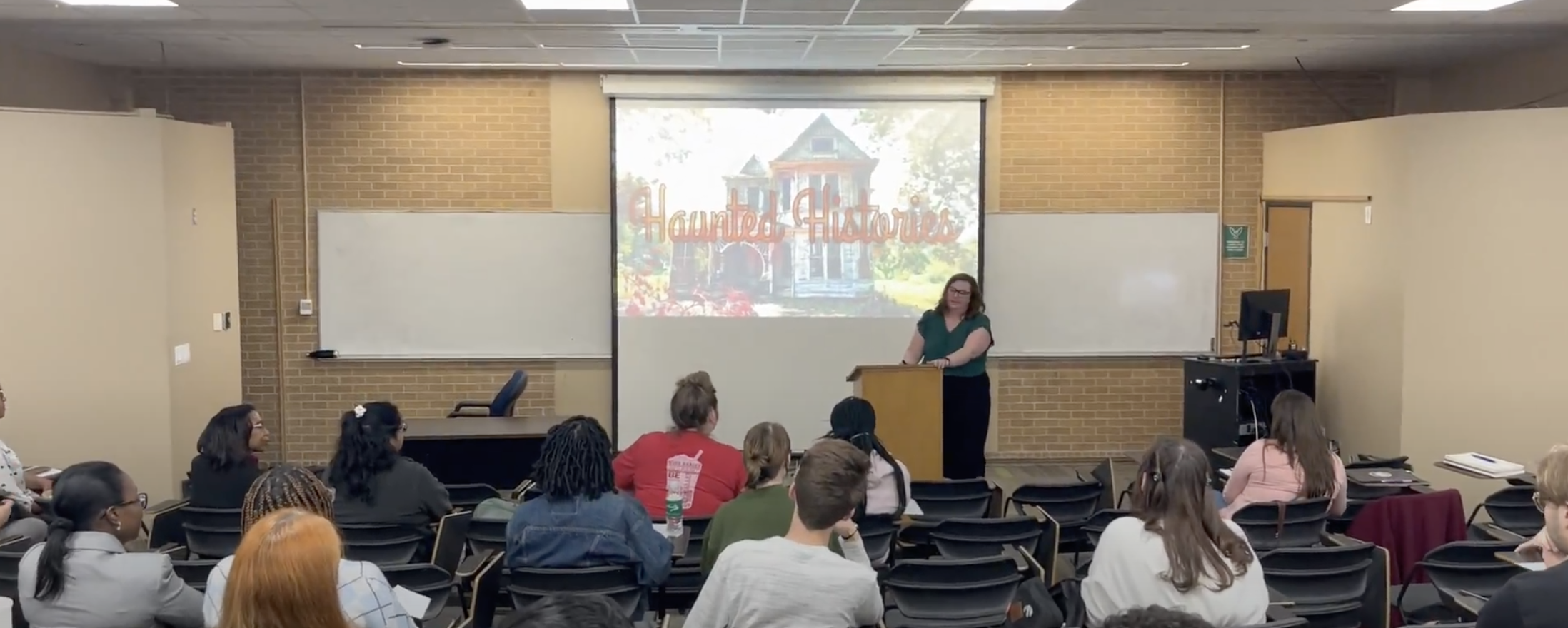
From the fall of 2018 until the summer of 2025, I served as a Graduate Teaching Assistant at the University of North Texas. During that time I was honored to work as the TA in ELEVEN sections of U.S. History to 1865, responsible for the grading and care of nearly 1500 students.
-
From the fall of 2018 until the summer of 2025, I served as a Graduate Teaching Assistant at the University of North Texas. During that time I was honored to work as the TA in FIFTEEN sections of U.S. History 1865 to the Present, responsible for the grading and care of nearly 2000 students.
-
In the spring of 2019, I served as a Graduate Teaching Assistant at the University of North Texas in TWO sections of World Civilization, responsible for the grading, tutoring, and care of just over 100 students.
-
In my final semester as a Graduate Teaching Assistant at the University of North Texas, I served as TA for one online section of Modern European History through Film. I was responsible for grading the work of 30 upperclassmen.